Commercial solar · Ekurhuleni

Commercial solar for East Rand businesses

We design, finance, build and operate rooftop solar for businesses across the East Rand, from the airport’s industrial parks at Isando and Jet Park to Germiston, Boksburg and Springs.

Ekurhuleni pays registered business customers a credit for solar power fed into its grid, which changes how a system should be sized.

About 30

Industrial areas in the City's 2025 regional plans

3

Main business tariffs: B, E and D

R1.53/kWh

Winter export credit on Tariffs D and E, 2026/27

Who supplies you

City of Ekurhuleni or Eskom? Check your bill first

Most East Rand businesses buy their electricity from the City of Ekurhuleni, but Eskom supplies some areas of the metro directly. The supplier sets your tariff, your approval process and what solar saves.

Supply follows the distribution licence, not the municipal boundary. Vosloorus is an Eskom-supplied area inside the metro, and Katlehong is reported to be on Eskom supply too.

The name on your electricity account settles it. A City of Ekurhuleni account follows the City’s tariffs and approval process. An Eskom account follows Eskom’s, which this page does not cover.

Sources: parliamentary reply NW6513; ourpower.co.za area listings (Katlehong, not confirmed by the utilities).

Where we work

The East Rand, corridor by corridor

The City's 2025 regional plans name about thirty industrial areas across its three regions. We group them into six corridors. The buildings, the loads and the tariff change from one to the next, and so does the design.

Corridor 1

Isando, Spartan and Jet Park

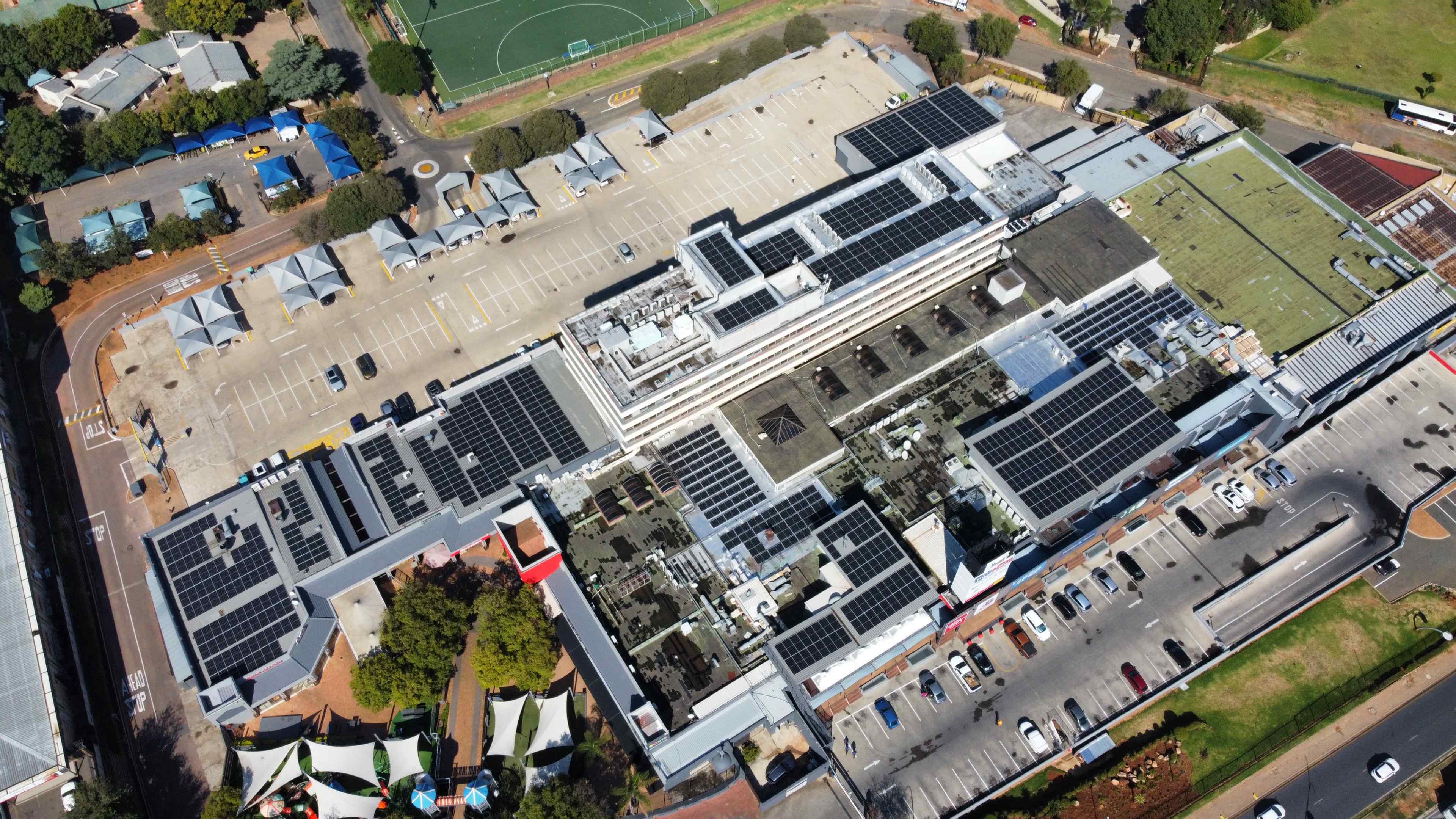
Areas: Spartan, Isando, Jet Park and Elandsfontein, around the R21, R24 and N12 west of O.R. Tambo, in Kempton Park.

What is here: Warehousing, logistics and manufacturing next to the airport, part of what the City calls the Albertina Sisulu Industrial Corridor.

What matters for solar: Large, flat warehouse roofs with daytime loads. On Tariff E, weekday output between 08:00 and 17:00 in winter displaces standard-rate energy.
Corridor 2

Chloorkop, Edenvale and Sebenza

Areas: Chloorkop-Commercia, on the border with Johannesburg's Modderfontein, and Eastleigh and Sebenza in Edenvale.

What is here: Light industry, distribution and manufacturing.

What matters for solar: On Tariff E, demand is billed only in peak and standard hours, so a lower daytime peak can count.

Corridor 3

Pomona to Olifantsfontein

Areas: Pomona and Bredell north of the airport, Witfontein near Tembisa, Clayville and Olifantsfontein along the R21.

What is here: Industrial and logistics parks along the R21; Olifantsfontein is the most recently developed.

What matters for solar: On a building still in design, solar costs least to add while the roof structure and the electrical room are being drawn.

Corridor 4

Germiston, Wadeville and Alrode

Areas: The industrial areas along the old mining belt (Jupiter, Driehoek, Germiston South, Knights, Balmoral, Lilianton, Comet) and the Alrode, Wadeville and Roodekop cluster in Alberton, with Roxton and Mapleton.

What is here: Industry along the old mining belt on both sides of the Germiston CBD, and the Alrode, Wadeville and Roodekop cluster between the N3, the N17 and the R59, stretching towards the planned Tambo Springs freight hub.

What matters for solar: On an older factory roof, a structural check comes before the panel layout. Vosloorus, nearby, is on Eskom supply, and Katlehong is reported to be, so check the bill.

Corridor 5

Boksburg and Benoni

Areas: Anderbolt, Dunswart and Boksburg East, with Benoni South and Apex.

What is here: One industrial cluster south of the airport that the City's plans treat as a whole.

What matters for solar: Plants running long shifts use solar for the daytime share. The export credit is worth less than the energy the site buys, so the daytime load still sets the size.

Corridor 6

Brakpan, Springs and Nigel

Areas: Vulcania, New Era and Fulcrum between Brakpan and Springs, Nuffield and Enstra near Springs, and Nigel's Gibela Rail, Prosperita, Vorsterkroon and Pretoriusstad.

What is here: Industrial complexes along the N17, the Gibela Rail site at Nigel, and a platinum refinery beside the Enstra industrial area.

What matters for solar: Large loads above 1 MVA move to Tariff D, with lower energy rates by voltage. A system above 1 MW falls outside the City’s small-scale embedded generation policy.

The corridors at a glance

CorridorThe City's industrial areasBusiness areas people search
Isando, Spartan and Jet ParkSpartan, Isando, Jet Park, ElandsfonteinKempton Park, East Rand
Chloorkop, Edenvale and SebenzaChloorkop-Commercia, Eastleigh, SebenzaEdenvale
Pomona to OlifantsfonteinPomona, Bredell, Witfontein, Clayville, OlifantsfonteinKempton Park, Tembisa
Germiston, Wadeville and AlrodeJupiter, Driehoek, Germiston South, Knights, Wadeville, Alrode, RoodekopGermiston, Alberton
Boksburg and BenoniAnderbolt, Dunswart, Boksburg East, Benoni South, ApexBoksburg, Benoni
Brakpan, Springs and NigelVulcania, New Era, Fulcrum, Nuffield, Enstra, NigelBrakpan, Springs, Nigel

Source: City of Ekurhuleni Regional Spatial Development Frameworks 2025 (Northern, Eastern and Southern regions).

Ekurhuleni solar registration

Registering solar with the City of Ekurhuleni

The City must approve a business system in writing before it is connected; systems without approval are disconnected.

Approval before construction. Above 18 kW, the application goes in with a single-line diagram, and the electrician who will issue the Certificate of Compliance lodges a commencement form. The City's first approval letter permits construction.

Sign-off. Above 18 kVA, the commissioning form is signed by an ECSA-registered professional or an accredited installer.

Final approval. The City needs the Certificate of Compliance, photographs of the dual-supply safety labels at the supply point, the as-built single-line diagram and the inverter's NRS 097-2-1 certificate.

System size. On a shared low-voltage feeder, the limit is 25% of the site’s notified maximum demand, up to 20 kW. Larger systems up to 1 MW may need a grid impact study; above 1 MW is outside the City’s small-scale policy.

Export credit. A registered net consumer with a four-quadrant bidirectional meter, paid for by the customer, earns a credit for every kWh fed into the grid.

Above 100 kW, NERSA too. NERSA registers grid-connected systems above 100 kW directly, after the City has approved the connection.

We prepare and submit the application to the City of Ekurhuleni and arrange its site inspection.

Who may do the work and who signs it off is set out in our guide to choosing a solar EPC partner. See also SSEG in the glossary.

Sources: City of Ekurhuleni SSEG process summary and Annexure E25 guideline (approved 29 May 2025); 2026/27 tariff schedule Annexure F; NERSA statement, 2 February 2026.

The bill

What solar takes off an Ekurhuleni bill

Every kWh your roof produces and the building uses comes off the bill at your tariff's energy rate for that hour. Ekurhuleni has no network surcharge and no percentage surcharge on the account.

Tariff B (up to 100 kVA or 150 A per phase).

One energy rate per season, so every solar kWh saves that season's rate.

Tariff E (above 25 kVA, below 1 MVA).

Time-of-use on a seasonal clock. On winter weekdays, output between 08:00 and 17:00 displaces standard-rate energy; summer windows run an hour later. Gazetted public holidays bill as Saturdays.

Tariff D (1 MVA and above).

The same seasonal clock, with lower rates by supply voltage.

Demand charges.

On Tariff E, demand is billed only in peak and standard hours; off-peak demand is not counted. The network access charge bills the highest peak or standard demand of the last twelve months, so one high month lasts a year. Across the systems we operate, solar typically lowers the billed peak by about 10%, within a range of 5% to 25%: a bonus on top of the energy saving, never part of the case.

Reactive energy.

Charged only when the power factor is 0.85 or lower, in peak and standard hours, in winter.

Export.

The City pays a credit for every kWh a registered net consumer feeds in: R1.53/kWh in winter and R1.05/kWh in summer on Tariffs D and E, and R1.15/kWh on Tariff B (2026/27, ex VAT). The credit is below the price of the energy you buy at the same time, so using your own output is worth more; we size for the building's load and count export at the credit only once the City has approved it.

The rates, the clock, the demand rules and the High Court review are on our page on Ekurhuleni electricity tariffs for 2026/27, and how demand is billed is in kVA and maximum demand charges in Gauteng.

Cost

What commercial solar costs on the East Rand

Our installed prices run from about R10,400 per kWp for a 50 kWp system to about R6,700 per kWp at 1 MWp, excluding VAT, for a grid-tied rooftop system.

System sizeInstalled price, ex VATPer kWp
50 kWpR520,000R10,400
100 kWpR870,000R8,700
200 kWpR1,570,000R7,850
500 kWpR3,620,000R7,240
1,000 kWpR6,700,000R6,700

A business that owns its system can deduct the full cost in the first year under Section 12B, for systems up to 1 MW. At the 27% company tax rate, that is R270,000 less tax per R1 million spent, a cashflow benefit in year one. You can also finance the system, or buy the power instead of the panels under a power purchase agreement or a partnership.

What moves the price, and what the bands exclude, is in our commercial solar cost guide.

How we work

From your meter data to 25 years of operation

Outages

Will solar keep my business running in a power cut?

A grid-tied system switches off when the grid goes down, as the safety standard requires. To keep running, a business needs a hybrid inverter and a battery, sized to the loads it must carry. How long the battery lasts depends on its charge when the outage starts and on the load connected.

Common questions

Commercial solar on the East Rand: FAQs

How much does commercial solar cost on the East Rand?

Our installed prices run from about R520,000 for a 50 kWp system (R10,400 per kWp) to about R6.7 million for 1 MWp (R6,700 per kWp), excluding VAT, for a grid-tied rooftop system. The price per kWp falls as the system grows. Roof structure, access, cabling distance and the grid connection move a specific quote.

Do I need City of Ekurhuleni approval for a business solar system?

Yes. The City must approve the system in writing before it is connected, and its first approval letter is what permits construction. Systems without approval are disconnected.

Does Ekurhuleni pay for solar power fed into the grid?

Yes, to registered net consumers with a four-quadrant bidirectional meter. In 2026/27 the credit is R1.53/kWh in winter and R1.05/kWh in summer on Tariffs D and E, and R1.15/kWh on Tariff B (2026/27, ex VAT). It is below the price of the energy you buy, so size the system to the building's daytime load first.

Is my business supplied by the City of Ekurhuleni or Eskom?

Check the name on your electricity account. Most East Rand businesses buy from the City of Ekurhuleni, but Vosloorus is supplied by Eskom and Katlehong is reported to be. The supplier sets your tariff and your approval process.

Does solar work during load shedding or a power cut?

A grid-tied system does not: it switches off when the grid fails, as the safety standard requires. A hybrid system with a battery keeps the connected loads running for as long as the battery's charge allows.

Will solar reduce my demand charge in Ekurhuleni?

Sometimes, and never dependably. On Tariff E, demand is billed only in peak and standard hours, and the network access charge carries the highest of the last twelve months, so one cloudy afternoon can set it for a year. Across the systems we operate, the billed peak typically falls by about 10%, within a range of 5% to 25%.

How big a solar system can my business install in Ekurhuleni?

On a shared low-voltage feeder, up to 25% of the site's notified maximum demand, to a maximum of 20 kW. Larger systems up to 1 MW may need a grid impact study, and the City's small-scale policy stops at 1 MW.

Which parts of the East Rand do you work in?

All of them, from Isando, Spartan and Jet Park to Germiston, Alberton, Boksburg, Benoni, Brakpan, Springs and Nigel.

Can my business claim Section 12B on a solar system?

Yes, if the business owns the system. Section 12B allows 100% of the cost as a deduction in the first year for systems up to 1 MW, worth R270,000 less tax per R1 million at the 27% company rate. A business that buys power under a power purchase agreement cannot claim it; the system's owner does.

Start with your meter data

Send us twelve months of electricity bills, or your meter's interval data if you have it. We'll check your supplier and tariff, and tell you what size of system your roof and your load support.